


The wrong kitchen paint finish looks fine until steam dulls it, grease clings near the stove, or one wipe leaves a shiny patch. Most regret starts with choosing sheen from a tiny color card.
For real kitchens and baths, durability has to live with your walls—not fight them. Satin usually lands best, but rough drywall, weak ventilation, and splash zones change the call.
Watch these trouble spots:
- Vanity walls that get hit every morning
- Ceiling condensation above the shower
- Old patchwork exposed by semi-gloss
Choose a finish you can live with on a Tuesday.
Why the Finish Matters More in Kitchens and Bathrooms
Paint finish gets treated like a style choice. In kitchens and bathrooms, it isn’t. It’s a working decision.
The finish affects three things at once: how the wall looks in real light, how easily it cleans, and how well it deals with steam, splashes, soap film, grease, and hands touching the same spots over and over. That’s why a finish that looks great on a sample chip can feel completely wrong once the room is in use.
We’ve seen the same hesitation from a lot of homeowners. They don’t want a wall that looks plastic. They also don’t want to repaint because the surface won’t clean up after six months. Both concerns are valid.
A kitchen or bath asks more from paint than a bedroom ever will:
- humidity rises and falls fast
- condensation sits on cool surfaces
- walls get wiped more often
- sink and vanity areas take direct splash
- cooking leaves residue higher up than people expect
And not every surface in the room needs the same answer. The right kitchen paint finish for broad wall areas may be wrong for trim, the ceiling, or the wall behind a sink.
Durability and appearance aren’t opponents. You need both.
If you keep that in mind, the decision gets a lot easier.
The Short Answer: The Best Kitchen Paint Finish for Most Homes
If you want the direct answer, here it is.
For most kitchen and bathroom walls, satin is the safest all-around choice. It gives you good washability, decent moisture resistance, and a softer look than semi-gloss. In most homes, that’s the sweet spot.
If you want a more muted wall, eggshell can work in lighter-duty spaces or rooms with better ventilation. It’s also more forgiving when the walls aren’t perfect, which matters more than people think. A shiny finish on patched drywall is brutal.
For trim, doors, and high-splash areas, semi-gloss is usually the stronger call. It cleans easily and handles repeated contact well.
For ceilings, flatter finishes can help hide flaws. In bathrooms that stay humid, though, a standard dead-flat ceiling paint may not hold up the way you want. Some rooms need a more durable ceiling product built for that environment.
One important line to draw: standard wall paint is not meant for shower interiors, steam rooms, saunas, or any surface that takes prolonged direct water exposure. That’s a different system.
The best sheen for bathroom walls still depends on four practical things:
- ventilation
- cleaning frequency
- wall condition
- how hard the room gets used
That nuance matters. But satin is where most people should start.
What Each Paint Sheen Really Does
The sheen ladder is simple on paper. The room makes it complicated.
In plain language, the usual options are flat or matte, eggshell, satin, and semi-gloss. As sheen goes up, the surface usually wipes down more easily. It also shows more. Every seam, patch, roller line, and uneven spot gets more visible.
Flat or matte
Flat hides flaws best. That’s its main strength.
It’s the weakest option for repeated washing and splash-prone walls, which is why we don’t love it for hardworking kitchens or bathrooms. It fits better on low-contact ceilings or dry areas that don’t need regular cleanup.
Eggshell
Eggshell has a soft, low-luster look that many people like right away. It feels quieter on the wall.
It’s more forgiving than satin or semi-gloss, especially on older walls with texture or patchwork. In a kitchen or bath, it can work if you’re using a better product made for humidity and cleaning. Cheap eggshell is where people get disappointed.
Satin
Satin is often the best paint finish for kitchens and bathrooms because it balances the room instead of fighting it. It wipes better than lower sheens and still looks calm enough on large wall areas.
If a homeowner asks us for one finish that usually lands well in real life, this is the one.
Semi-gloss
Semi-gloss is the most reflective finish in this group. It’s very cleanable and useful where splashes, fingerprints, and scrubbing are part of the deal.
Used on every wall, though, it can make a room feel harder and brighter than intended. In some bathrooms it reads clean. In others it reads clinical. Depends on the room, the light, and how smooth the walls are.
One more thing. Sheen matters, but product chemistry matters too. A strong kitchen-and-bath eggshell can outperform a weak satin. The label matters almost as much as the shine level.
The label does not set one fixed level of shine
A manufacturer’s measured reference values show why it is worth looking beyond the sheen name. Across selected interior product lines, the 60-degree gloss range for satin is 7 to 25 gloss units, while eggshell spans 5 to 13. Semi-gloss is distinctly higher at 30 to 45, but “satin” and “eggshell” can sit much closer together than their labels suggest.
Reference 60-degree gloss ranges for selected Sherwin-Williams interior paint lines. Eggshell and satin overlap somewhat, while semi-gloss is substantially higher.
| Sheen | Low gloss units | High gloss units |
|---|---|---|
| Eggshell | 5 | 13 |
| Satin | 7 | 25 |
| Semi-gloss | 30 | 45 |
Source: Sherwin-Williams Gloss and Sheen Guide. Reference values measured at 60 degrees on force-dried 4-mil-wet films.
- The values are manufacturer reference ranges for selected Sherwin-Williams interior product lines, not a cross-brand market survey.
- The guide states that its references are measured at 60 degrees on force-dried films at 4 mils wet; real-world appearance also depends on lighting, substrate, color, and application.
View chart data
| Sheen | Low gloss units | High gloss units |
|---|---|---|
| Eggshell | 5 | 13 |
| Satin | 7 | 25 |
| Semi-gloss | 30 | 45 |
These are manufacturer reference values, measured on force-dried 4-mil-wet films, not a universal standard for every paint brand or formula. Use them as a reminder to compare the specific product and test a sample in the room’s actual light. Sherwin-Williams’ gloss and sheen guide also notes that gloss readings depend on the measurement angle and product line.
Satin vs Semi-Gloss Bathroom: Which One Wins?
This is where people get stuck, and for good reason. Both finishes can work. They just solve different problems.
For most main bathroom walls, satin wins. It handles regular wiping and humidity without pushing too much glare back into the room. It looks more relaxed, and that matters when you’re covering full wall areas.
Semi-gloss steps ahead when the bathroom is under more stress:
- poor ventilation
- heavy daily use
- vanity walls that get constant splash
- a household that wipes walls often
- the owner wants maximum cleanability and doesn’t mind more shine
The visual tradeoff is simple. Satin looks softer and more current on walls. Semi-gloss reflects more light and draws more attention to texture, repairs, and uneven surfaces.
The maintenance tradeoff is real too. Semi-gloss tends to release residue more easily during cleaning. Satin is still washable in a quality kitchen-and-bath formula, but it won’t feel as slick under a sponge.
Here’s the quick side-by-side:
- Appearance: satin is softer, semi-gloss is brighter
- Durability: semi-gloss has the edge
- Cleanability: semi-gloss is easier to wipe hard
- Defect visibility: satin is safer on imperfect walls
If the walls are smooth and the bathroom gets hammered every day, semi-gloss may be worth it. If the walls have history, and most walls do, satin is usually the better everyday answer.
| Metric | Satin | Semi-gloss | Buyer impact |
|---|---|---|---|
| Best use on bathroom walls | Usually the better everyday answer for most main bathroom walls | Worth it when the bathroom gets hammered every day | Start with satin unless room stress is unusually high |
| Appearance | Softer, more relaxed, more current on walls | Brighter and more reflective | Choose satin if you want less glare across full wall areas |
| Durability | Handles regular wiping and humidity | Has the edge | Semi-gloss is the safer pick for harder-use bathrooms |
| Cleanability | Washable in a quality kitchen-and-bath formula but not as slick under a sponge | Easier to wipe hard and tends to release residue more easily | Pick semi-gloss if walls get frequent hard cleaning |
| Defect visibility | Safer on imperfect walls | Draws more attention to texture, repairs, and uneven surfaces | If walls have history, satin is the lower-risk choice |
| When it makes the most sense | Most bathrooms with typical humidity and routine wiping | Poor ventilation, heavy daily use, constant vanity splash, frequent wall wiping, or maximum cleanability matters more than shine | Use room conditions, not habit, to break the tie |
The Best Sheen for Bathroom Walls by Bathroom Type
Not every bathroom lives the same way. A powder room and a family bath shouldn’t be painted like twins just because they share plumbing.
Powder room
This is the easiest one. Lower steam, lighter use, less daily abuse.
Eggshell or satin can both work here. If the room is more about appearance and less about constant moisture, a softer finish is often the nicer choice.
Family bathroom
This room gets no mercy. Showers, toothpaste spray, damp towels, kids touching walls with wet hands.
Satin is usually the best sheen for bathroom walls in a family bath. It holds up without making every surface too reflective. Around vanity areas or other busy splash zones, semi-gloss may make sense.
Small bathroom with weak airflow
This is the room that exposes bad paint decisions fast. Condensation hangs around longer, especially on outside walls and ceilings.
Lean toward satin or semi-gloss in a product line meant for kitchens and baths. But let’s be blunt: ventilation problems can’t be solved with sheen alone. If the fan is weak or unused, the paint is being asked to cover for a room issue.
Guest bathroom
Lower wear gives you more freedom. Eggshell may be fine here if the paint still has decent washability and is made for humidity-aware interiors.
Commercial or shared-use restroom
Different standard. Here, washability and durability come first.
A more scrub-resistant coating matters more than subtle aesthetics, especially where stronger cleaners may be used. Pretty stops mattering once the wall gets wiped three times a day.
Also, mildew resistance on the can usually refers to the paint film itself. It does not fix moisture trapped behind the wall, hidden leaks, or failing caulk.
The Best Paint Finish for Kitchens by Surface
Kitchens fail by surface, not by room. The wall behind a table doesn’t live like the area next to a cooktop.
For main kitchen walls, satin is usually the strongest recommendation. It handles fingerprints, food splatter, and routine wipe-downs without looking too glossy.
Near the stove, sink, and trash area, the durability bar goes up. Those concentrated splash zones often benefit from semi-gloss if the look fits the space. Those are the spots that tell the truth by the second afternoon.
Kitchen ceilings get overlooked. They shouldn’t. Grease aerosol and moisture rise, especially near cooking areas. A dead-flat ceiling finish may hide flaws, but it can be the wrong call in a hardworking kitchen if staining and wipe-downs are likely.
For trim, doors, and window casings, semi-gloss remains a common fit because it handles contact well and cleans easily.
A separate note on cabinets: cabinet coatings are not the same decision as wall paint. Cabinets need a harder, smoother enamel-style product. Using standard wall paint there is a shortcut that rarely ages well.
And when someone says they want a washable paint for kitchens, we think beyond sheen. It also needs to resist staining and repeated cleaning. Shine alone doesn’t buy that.
What Makes a Paint Truly Washable in Wet and Messy Rooms
A lot of people assume shinier means better. That’s only half true, and sometimes not true at all.
A washable paint for kitchens depends on the whole formula, not just the finish. If you’re comparing products, look for performance language that actually speaks to the room:
- moisture resistant or humidity tolerant
- made for kitchens, bathrooms, or laundry rooms
- stain resistance
- frequent washing or scrubbing
- mildew-resistant coating
- low odor or low VOC for occupied homes
- good adhesion to typical interior surfaces
Most better kitchen and bath paints today are water-based acrylics. Many are ready for another coat in about 2 to 4 hours under normal conditions. Coverage often lands around 400 to 450 square feet per gallon, depending on the product and the wall.
Those numbers help with planning, but they don’t tell the whole story. Some premium coatings are tested for heavy wash resistance and higher scrub performance. That’s where the better products separate themselves.
For small commercial spaces or shared properties, cleaning demands can be harsher. If the wall needs to tolerate stronger cleaners or more frequent disinfecting, the finish has to be chosen with that in mind. Residential assumptions don’t always carry over.
When a Lower-Sheen Finish Is the Smarter Choice
Less shine is not a mistake. Sometimes it’s the disciplined choice.
Eggshell or another softer finish can be the better answer when the walls have old patches, waviness, visible texture, or uneven plaster. Higher sheen doesn’t fix those issues. It frames them.
A lower sheen also makes sense when:
- the room has good ventilation
- daily wear is moderate
- you want a warmer, less reflective look
- design matters more than maximum scrub resistance
Here’s the part people don’t love hearing: showroom photos lie by omission. They don’t show the repaired corner, the skim coat that wasn’t perfect, or the overhead light that rakes across the wall at night.
Higher sheen exaggerates:
- drywall seams
- roller overlap
- old repairs
- surface ripples
- harsh light reflection
The best finish is the one that still looks good on an average Tuesday, not just right after painting.
That’s the standard we use.
How to Choose the Right Finish for Your Specific Room
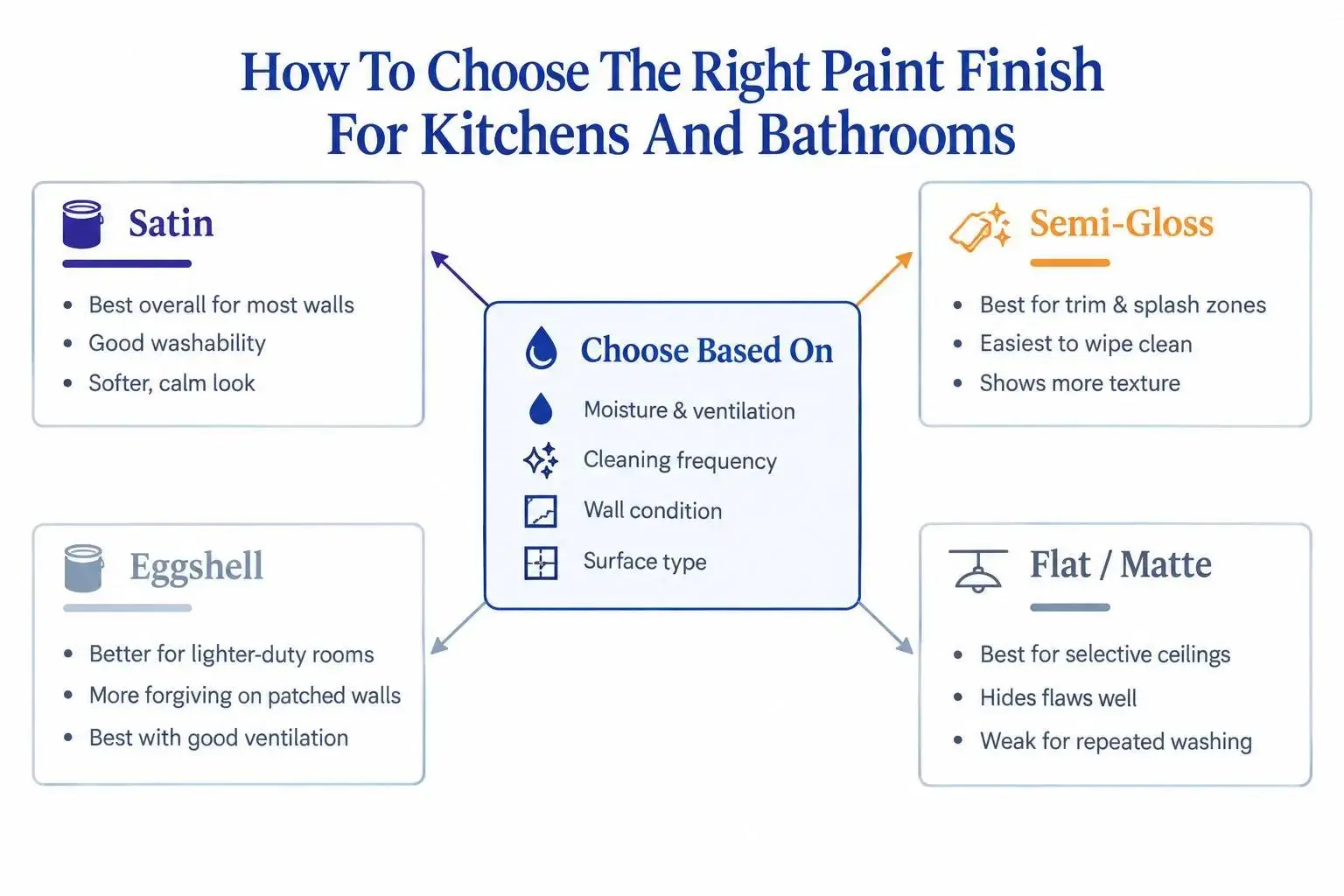
If you’re stuck between two finishes, stop thinking in brand terms and start with room conditions.
Use this decision frame:
Decision factors
- Steam level
How much steam does the room create?
More showers, boiling, and weak airflow push the choice toward a more durable, moisture-aware finish. - Cleaning needs
How often will the walls be cleaned?
Kids, tenants, heavy cooking, and busy bathrooms all increase the value of washability. - Wall smoothness
How smooth are the walls?
If the surface has flaws, be careful with semi-gloss on broad wall areas. - Preferred look
What look do you actually want to live with?
For softer, understated walls, satin or eggshell usually makes more sense. For crisp trim contrast, semi-gloss still earns its place. - Ventilation
How good is the ventilation?
Good ventilation gives you flexibility. Poor ventilation narrows your options fast. - Project scope
Is this a quick refresh or part of a larger renovation?
If lighting, layout, trim, or flooring are also changing, the right finish may shift with them.
The short matrix looks like this:
- Best overall for most walls: satin
- Best for a softer appearance: eggshell
- Best for trim and splash-prone details: semi-gloss
- Best for hiding flaws: flatter finishes, used selectively
Simple beats clever here.
Product Label Clues That Help You Avoid the Wrong Paint
The color chip gets the attention. The label makes the decision.
When you’re reading the can or product page, look for direct wording about kitchens, bathrooms, laundry rooms, or high-humidity spaces. If it doesn’t mention the type of room you’re painting, slow down.
Performance terms worth paying attention to include:
- scrubbable
- stain resistant
- moisture resistant
- mildew-resistant coating
- durable finish
Low odor or very low VOC can matter a lot in occupied homes, apartments, or small commercial spaces where downtime is limited.
Many products call for two full coats to achieve the intended finish and performance. That’s normal. Trying to stretch one coat and a touch-up into a finished job usually shows.
A few practical notes people miss:
- some paints shouldn’t be applied below 50 degrees Fahrenheit
- poor drying conditions can hurt performance
- some kitchen and bath products are intended for brush or roller use rather than improvised spraying
- don’t mix paint types or add anything unless the manufacturer says it’s allowed
The wrong product often looks fine on day one. Problems show up later.
Prep and Application Matter as Much as the Finish
A good kitchen paint finish won’t save a dirty wall. Paint is honest that way.
Grease, soap film, chalky residue, loose material, damp patches, failed caulk, all of that has to be dealt with first. At minimum, prep should include:
- cleaning the surface properly
- repairing cracks, dents, and failed caulk
- letting new drywall, plaster, or patches dry fully
- priming where needed, especially on bare wood, stains, tile, or problem spots
Higher sheens also make touch-ups more obvious. That’s another reason prep and full-coat consistency matter. Patch-and-pray is not a system.
Most paint systems need two coats for even sheen and decent washability. And dry is not the same as cured. A wall may be ready for another coat in a few hours but still need much longer before hard use, scrubbing, or repeated cleaning.
If there’s active mold, recurring condensation, or a hidden moisture issue, don’t paint over it and hope for discipline from the room. The room won’t cooperate.
When Paint Is Not Enough
Sometimes the paint question is really a room question.
If a bathroom has chronic moisture, peeling paint, weak airflow, or damaged surfaces, finish selection alone won’t fix it. Better ventilation, substrate repair, and correcting the cause matter just as much as the coating on top.
If walls are being opened, moved, or rebuilt, that’s where our demolition and installation framing work fits naturally. It’s not a paint add-on. It’s the step that gets the room back to something worth painting.
For fuller updates, we also handle bathroom remodeling in Brooklyn and Manhattan, including reconstruction work where waterproofing and ventilation are part of the real solution. In kitchens, finish choices are usually easier when they’re considered alongside lighting, flooring, trim, and overall wear patterns instead of in isolation.
Paint can solve a paint problem. It can’t solve a failing room.
Common Mistakes That Lead to Regret
Most finish regrets are predictable. People just don’t see them coming until the room is done.
The common ones are:
- choosing the highest sheen by default, then hating how much it shows
- using a flat decorative finish in a hardworking kitchen or bath
- assuming mildew-resistant paint can beat hidden leaks or no exhaust fan
- treating cabinet paint like wall paint
- skipping prep on greasy or damp surfaces
- forgetting that lighting changes sheen from wall to wall
- buying for color only and ignoring washability or humidity use
- using one finish everywhere instead of matching it to the job
One mistake sits underneath all of them: choosing for an ideal version of the room instead of the real one.
Conclusion
For most homes, the best kitchen paint finish for walls is satin. It gives you the balance most rooms need. Eggshell works when you want a softer look and the space has lighter wear or better ventilation. Semi-gloss still makes the most sense on trim, splash-prone details, and tougher-use areas.
The right paint finish for kitchens and bathrooms comes down to four things: moisture, cleaning demands, wall condition, and the look you can live with every day. That’s it. Once you judge the room honestly, the decision usually gets simpler.
Test the finish against the actual space, not the showroom version of it. Look at the light, the traffic, the steam, the patched spots, the sink splash, the ceiling near the cooktop. That’s the room you’re painting.
If your project includes interior painting or a larger kitchen or bathroom update, we can help you sort out the finish choices around how the space will really be used. That usually leads to better results and fewer do-overs.