


Before you refinish or replace hardwood floors, look past the scratches. A dull traffic lane can be saved; soft spots, cupped boards, and black water stains usually mean the problem runs deeper.
What matters is whether the wood is still stable, thick enough to sand, and dry underneath. Don’t pay for a cosmetic fix that hides a moisture problem.
Start by checking:
- Whether damage stops at the finish or reaches the boards
- If engineered flooring has enough real wood left to sand
- What tear-out adds: subfloor repairs, trim, and transitions
Make the call once, and make it stick.
The Quick Rule: Refinish Surface Problems, Replace Structural Problems
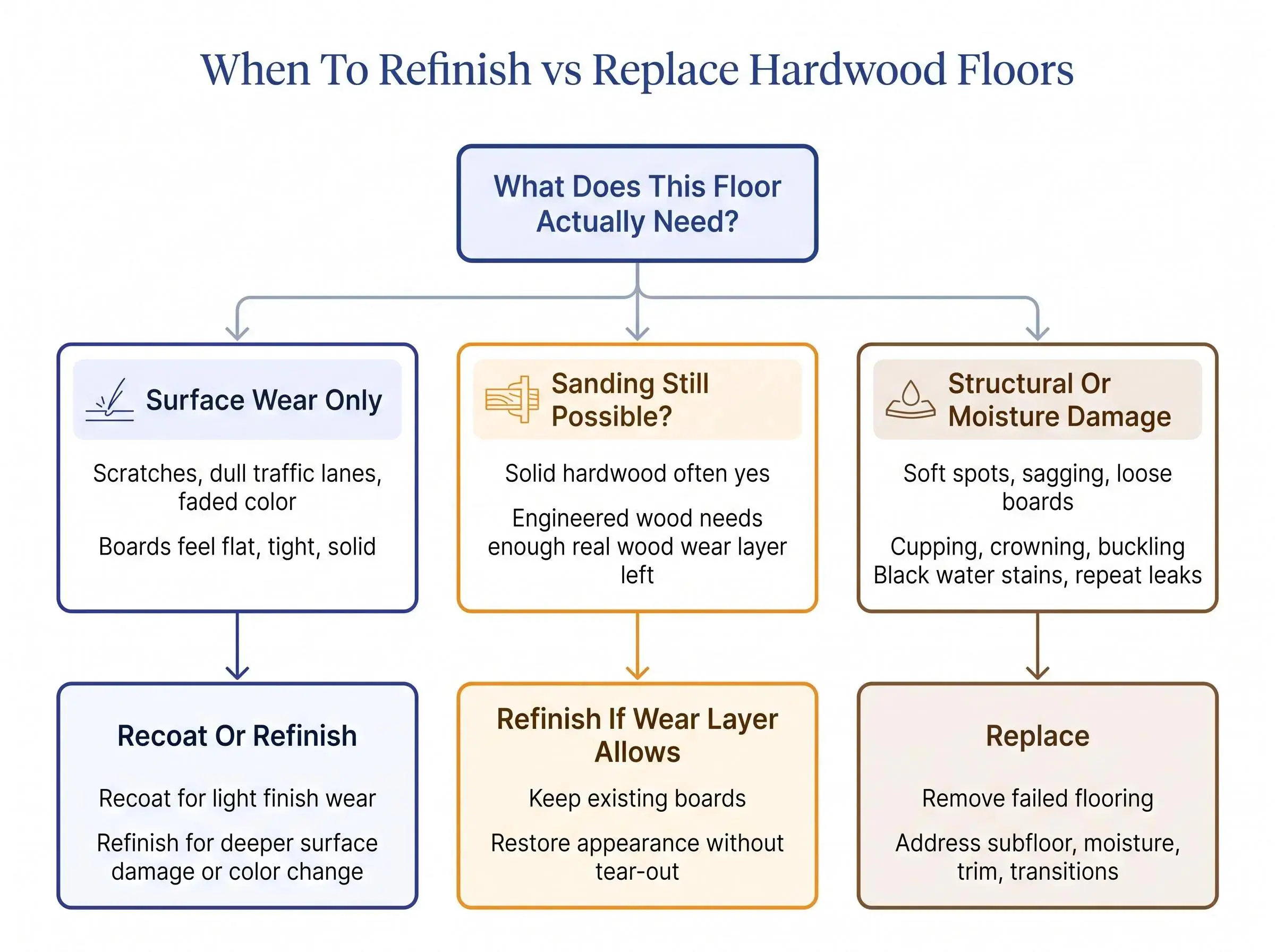
If you want the shortest honest answer, here it is: refinish surface problems, replace structural problems.
A lot of floors look worse than they are. Scratches, dull traffic paths, faded stain near windows, old amber color, scuffs from chairs, even light staining, those issues often live in the finish or near the top of the wood. They may look rough every time you walk in the room, but they do not automatically mean the floor is done.
Replacement becomes the better call when the floor is moving, failing, or staying wet long enough to change shape. That usually looks like:
- warped or buckled boards
- cupping or crowning that keeps coming back
- soft or sagging areas
- loose boards that shift underfoot
- repeated water damage
- wood that has been sanded down too many times
This is the part people miss: appearance alone is a bad judge. We’ve seen floors that looked tired but were still solid candidates for sanding and staining. We’ve also seen floors that looked only mildly worn until you stepped on them and felt the subfloor tell the real story.
Don’t start with “Which option is newer?”
Start with “What does this floor actually need?”
That one question saves people money.
Hardwood Floor Refinishing vs Replacing: What Each Option Actually Means
People use these terms loosely, and that causes bad decisions.
Refinishing means keeping your existing floor, sanding off the old finish and a thin layer of wood, then applying stain if you want a different color, followed by a new protective topcoat. The boards stay in place. You’re restoring what’s already there.
Replacement means removing the existing flooring, checking what is happening below it, fixing subfloor issues if needed, and installing new wood flooring. That opens the door to changing more than just color. You can change species, plank width, board construction, and the overall look.
The tradeoff is simple:
- Refinishing keeps the original boards and usually keeps the character of the home.
- Replacing gives you a clean slate, but it also creates more moving parts.
Those extra moving parts matter more than people expect. Replacement can affect thresholds, door clearances, base trim, adjacent room transitions, and sometimes floor height. On paper it sounds straightforward. In the room, it rarely stays that clean.
At Ardson Construction, our wood floor sanding and staining work sits on the refinishing side of this decision. Our wood flooring installation work fits the replacement side when the existing floor is no longer worth saving. We don’t treat those as interchangeable services, because they aren’t.
You May Have More Than Two Options
Not every worn floor needs full refinishing. Not every tired floor needs to be torn out either.
Sometimes the smartest move is lighter.
Screen and recoat
A screen and recoat is a refresh for floors where the finish looks dull or scuffed, but the wood itself is not deeply worn through. The old surface is lightly abraded so a new coat can bond, then a fresh protective coat goes on top.
Typical pricing often lands around $1 to $2 per square foot, which is well below full sanding. That’s why it’s worth asking about before jumping into a bigger job.
A recoat does not fix everything. It won’t remove deep scratches, it won’t level stain differences, and it won’t let you change color. But if your floor just looks tired, it can buy you time in a good way.
Reoiling
Some floors finished with natural oil or hardwax oil can be reoiled instead of fully refinished. If the finish looks dry or faded but the wood is still in good shape, reoiling may be enough.
This is more niche, and it only applies to the right floor system. Still, it’s another reason not to force every problem into a sand-or-replace decision.
A useful way to think about it:
Recoating adds protection. Refinishing removes material so deeper wear can be corrected.
That difference matters.
Signs Your Floors Are Good Candidates for Refinishing
A refinish works best when the floor is still structurally sound and the damage is mostly visual.
Here are the signs we look for first:
- surface scratches and scuffs
- light dents that haven’t broken the floor’s stability
- dull finish in hallways, entries, kitchens, or other heavy traffic areas
- uneven color from sun exposure or old rug placement
- shallow stains that haven’t soaked too deep
- boards that feel flat, tight, and solid underfoot
- original solid hardwood with enough wear layer left
- a floor where the main goal is changing stain color, not changing the floor itself
That last one comes up a lot. People assume they need new wood because they hate the current tone. Usually they hate the color, not the floor.
If the boards are still sound, refinishing can add real life back to them. Many floors get another 7 to 10 years or more after a proper refinish, depending on traffic and maintenance. That’s not a small extension.
One operator’s note here: if the floor looks worst in paths between the front door, kitchen, and hallway, but the boards still sit flat and firm, that often points to finish wear, not floor failure. Ugly isn’t the same as unsalvageable.
Signs It Is Time to Replace the Floor
Some floors are asking for more than sanding. You can hear it before you price it.
Boards that are warped, buckled, badly cupped, or crowned usually point to moisture movement that goes deeper than finish wear. If the floor has sagging sections, repeated squeaks from looseness, or a subfloor that feels soft or unstable, refinishing doesn’t solve the real problem.
Replacement becomes more likely when you see things like:
- deep black water staining across broad areas
- loose or shifting boards
- visible nail heads or signs the floor has already been sanded too far
- tongues getting close to exposure
- engineered planks with thin veneer or delamination
- repeat leak history
- chronic moisture exposure near exterior walls, kitchens, or plumbing lines
- a planned layout or flooring change that makes keeping the old floor impractical
Sometimes the issue isn’t just the wood on top. It’s what sits under it. If replacement is tied to larger renovation work, prep matters. Old flooring may need removal, damaged layers may need to come out, and framing or subfloor corrections may be part of the job. That’s where demolition and installation framing can matter, especially when the floor problem is tied to a broader reset.
A floor can be finished out beautifully and still fail because nobody dealt with what was underneath. That’s money spent in the wrong order.
Solid Hardwood vs Engineered Wood Changes the Answer
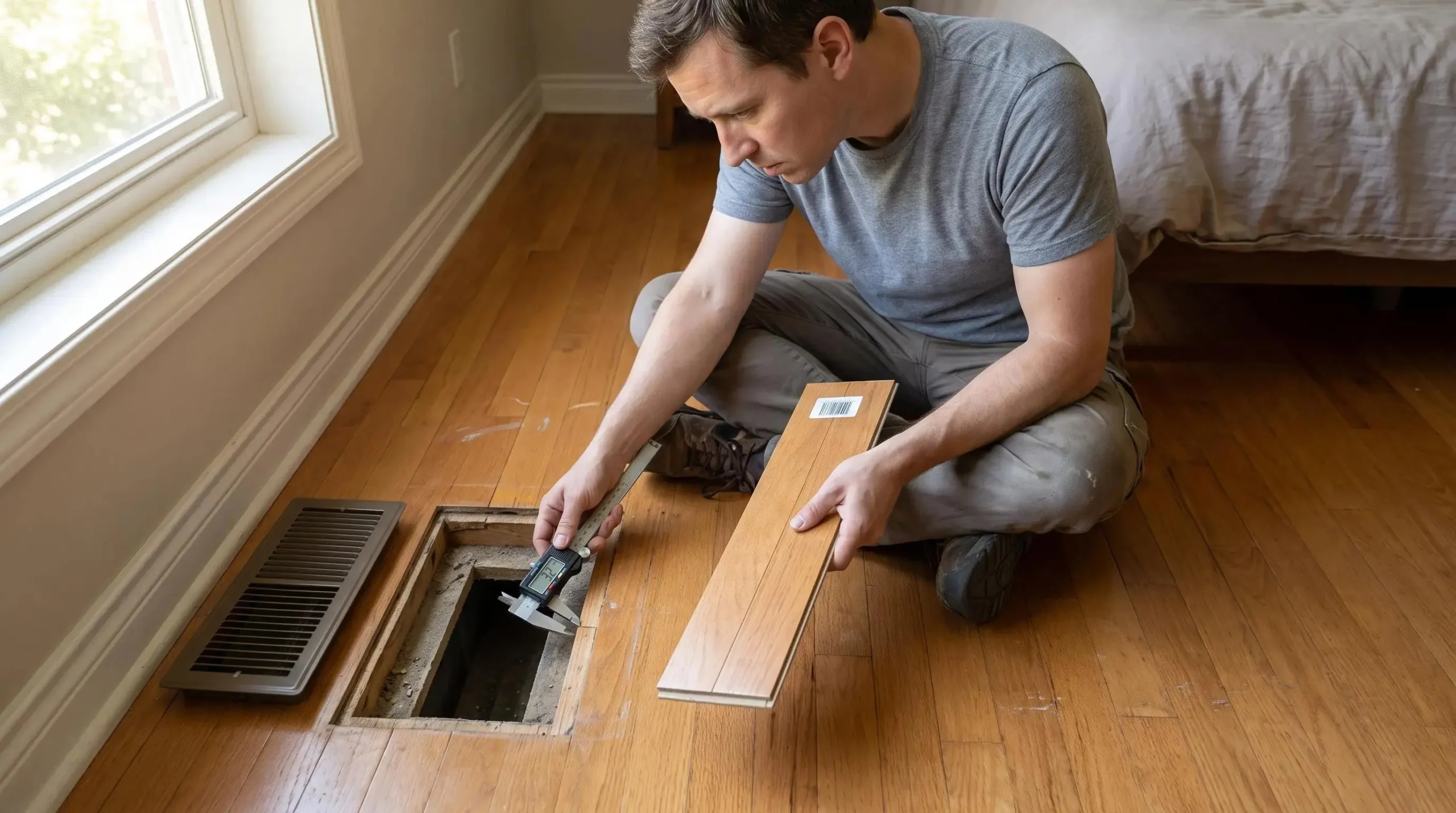
Before anyone tells you to sand the floor, they need to know what the floor actually is.
Solid hardwood usually gives you more room to work with. Because the wear layer is thicker, it can often be refinished multiple times over its life. Not forever, but more than once or twice in many cases.
Engineered wood is different. The top is real wood, but that real wood layer may be thin. Some engineered floors can be refinished once or twice. Some are poor candidates from day one.
A useful threshold is roughly 3/32 inch, or about 2.5 to 3.2 mm, of usable wear layer. Floors around that range are stronger candidates for sanding. Very thin engineered veneers, especially under about 2 mm, are risky. There’s not much room for correction.
The wear-layer threshold depends on the finish
The National Wood Flooring Association’s refinishable-program benchmarks make that range more specific: factory-finished smooth or sculpted engineered flooring needs at least 2.5 mm of wear layer, while unfinished smooth engineered flooring needs 3.2 mm. The difference matters when comparing products or judging whether an unfinished floor can be sanded now and still retain a refinishable layer later.
How to check without guessing
Look at:
- a floor vent opening
- a threshold edge
- a leftover plank if you have one
- any exposed cross section where the board build is visible
Two floors can look equally worn from above and have completely different answers once you see the construction. That catches people off guard.
This is why photo-only advice has limits. The top surface tells part of the story. The cross section tells the rest.
| Engineered flooring condition | Minimum wear layer (mm) | Minimum wear layer (32nds in.) |
|---|---|---|
| Factory-finished smooth or sculpted/distressed | 2.5 | 3 |
| Unfinished smooth | 3.2 | 4 |
These are program minimums, not a promise that any individual floor can be refinished. Prior sanding, flatness, damage, and the lowest remaining point in a textured surface still need an in-person assessment.
Cost of Refinishing Hardwood Floors vs Replacing
Let’s get to the part most people are really measuring: money.
The cost of refinishing hardwood floors vs replacing is usually not close. Refinishing commonly falls around $3 to $8 per square foot. Full replacement often lands around $6 to $18 or more per square foot, depending on the wood, the installation conditions, and what has to happen before new boards go down.
Common refinishing ranges often look like this:
- standard sand and refinish: around $3 to $4 per square foot
- sand, stain, and refinish: around $4 to $5 per square foot
- screen and recoat: around $1 to $2 per square foot
The cost of refinishing vs replacing hardwood floors depends on more than square footage, though. It depends on whether the floor is actually salvageable.
Refinishing costs tend to rise when the job includes deeper scratches, stain changes, board repairs, stairs, furniture moving, or awkward room access. More sanding passes and more prep usually mean more labor.
Replacement costs climb for different reasons. Material choice is a big one, but not the only one. You also have:
- demolition and disposal
- subfloor prep or repair
- trim and threshold work
- matching nearby floor height
- layout complexity
- acclimation and scheduling around material delivery
Here’s the trap: people compare a refinish number to the cost to replace wood floors and forget everything under the finish line. Removal, disposal, subfloor correction, and transitions can change the job fast.
| Option | Low cost per sq ft | High cost per sq ft |
|---|---|---|
| Screen and recoat | 1 | 2 |
| Standard sand and refinish | 3 | 4 |
| Sand, stain, and refinish | 4 | 5 |
| Refinishing overall | 3 | 8 |
| Full replacement | 6 | 18 |
Is It Cheaper to Refinish Hardwood Floors or Replace?
Yes, in most cases, refinishing is cheaper when the existing wood is sound.
That’s the straight answer to “is it cheaper to refinish hardwood floors or replace.” Usually, yes.
But the cheaper number only wins if it solves the problem. If the floor has moisture damage, structural failure, or too little wear layer left, a refinish can turn into a short delay before a larger replacement bill.
Think about value this way:
- Refinish when the wood is worth preserving.
- Replace when refinishing would only postpone failure.
- Don’t pay for a cosmetic fix on a structural problem.
We’ve seen owners chase the lower upfront cost and end up paying twice. Sand now, replace next year. That is rarely a bargain.
For landlords and small commercial clients, the calculation shifts a bit. Downtime matters. Turnover windows matter. Repeat maintenance matters. If a replacement gives you a cleaner, longer-lasting reset during a tight vacancy period, that may beat a lower sanding price that doesn’t hold up.
The right answer is usually the least invasive option that fixes the real issue. Not the cheapest line item. The real issue.
Timeline, Mess, and Daily Life During the Project
This part gets ignored until the job starts, and then it becomes the only thing anyone talks about.
Refinishing often takes around 3 to 5 days, depending on sanding, staining, number of finish coats, humidity, and cure time. You usually need to stay out of the work area while finish dries, and furniture has to be planned for before day one.
Replacement can take longer because there are more stages:
- tear-out
- disposal
- subfloor review and repair
- material delivery and acclimation
- installation
- trim or transition adjustments
Refinishing can be dusty and disruptive, even when dust control is handled well. Replacement adds demolition noise, more debris, and more variables.
A few practical questions matter more than people think:
- Can you use the room during the project?
- Where is the furniture going?
- Will nearby room transitions change height?
- Will doors or trim need adjustment?
Humidity and temperature also affect the schedule. Finish drying doesn’t care about your weekend plan, and wood movement doesn’t care about a delivery deadline.
That sounds blunt, but it’s better to know it upfront.
When a Partial Repair Is Smarter Than Full Replacement
Sometimes the smartest answer is smaller.
If the damage is isolated, a few boards can often be replaced before the rest of the floor is refinished. That works well for localized leak damage, a couple of cracked boards, limited pet stains, or a small impact area from something dropped hard enough to matter.
This middle option works best when the surrounding floor is still stable and sandable. If one section is bad but the field around it is solid, targeted board replacement can save the job from becoming a full tear-out.
The catch is visual blending. Matching species, board width, grain character, and final finish takes judgment. Some patches disappear well after sanding and staining. Some don’t. Old red oak that’s darkened over time won’t always behave like fresh wood dropped into the middle of the room.
Still, replacing a few boards is not the same thing as needing a whole new floor. People jump from “there’s damage here” to “everything has to go.” That’s often the wrong jump.
If staining is spread across many rooms, if movement is widespread, or if wear is all over the house in different ways, then broader replacement starts making more sense.
Design Goals Can Change the Right Answer
Not every floor decision starts with damage. Sometimes you’re just done with the look.
If your main goal is changing an old stain color, refinishing may be enough. A lot of yellowed, red-toned, or uneven floors can be sanded back and brought into a more natural, medium, or darker finish without replacing the boards.
Replacement makes more sense when you want a bigger design shift, such as:
- a different wood species
- wider planks
- a new board construction type
- a switch to a different flooring category altogether
Some clients also want prefinished boards because they prefer factory-finished surfaces or want more texture and style choices. That’s a valid reason to replace, as long as the budget and floor height conditions support it.
At Ardson Construction, our wood flooring installation work includes options from classic hardwoods to modern engineered wood when replacement is the better fit. But even then, the floor still has to make sense in the room. Good design doesn’t cancel out subfloor limits, transition problems, or budget reality.
A nice finish color can change a room. So can a bad material decision.
What a Good Floor Assessment Should Check Before Recommending Anything
A serious floor assessment should be hands-on. Not just a quick glance and a sales pitch.
We want to know:
- how worn the finish is
- whether bare wood is exposed
- if boards are moving, cupping, or buckling
- how much wear layer is left
- whether there are moisture signs, old or active
- what the subfloor feels like under load
- whether damage is isolated or spread across connected rooms
- what you’re actually trying to accomplish
That last one matters more than people expect. Restore the original look? Change color? Get the place ready to sell? Solve a leak-damage problem and move on? The right recommendation changes with the goal.
At Ardson Construction, we lean on detail-focused evaluation and straightforward pricing because vague advice wastes time. If the honest next step is sanding and staining, we should be able to explain why. If the floor needs replacement, we should be just as clear about that.
Photos help start the conversation. They should not finish it.
Common Mistakes Homeowners Make When Deciding
Most bad floor decisions come from rushing the diagnosis.
Here are the mistakes we see most often:
- assuming ugly floors automatically need replacement
- assuming every scratch or stain will sand out
- ignoring whether the floor is solid hardwood or engineered
- comparing refinishing to the cost to replace wood floors without counting disposal, subfloor work, trim, and transitions
- choosing based only on color preference when refinishing could already get there
- skipping screen and recoat for floors that only have finish wear
- treating moisture symptoms as cosmetic
- waiting too long once finish wear exposes bare wood
That last one matters. Once bare wood is taking traffic, spills, and dirt directly, your options can narrow faster than people expect. A floor that could have been recoated last year may need full sanding now. A floor that could have been sanded may end up with stained areas that no longer clean up well.
Don’t wait for certainty so long that the floor loses its easier options.
Conclusion
Most decisions about whether to refinish or replace hardwood floors come down to one thing: is the problem cosmetic, structural, or somewhere in between?
The working framework is simple:
- recoat for light finish wear
- refinish for sound floors with surface damage or an outdated color
- replace when the boards or subfloor are failing, or when the floor can’t be sanded safely
The cost of refinishing hardwood floors vs replacing matters. Of course it does. But accuracy matters more than chasing the lowest number on page one.
Get the floor assessed in person. Ask what condition the wood is actually in. Ask about the subfloor. Ask for clear pricing for both refinishing and replacement if the answer isn’t obvious. Once you know what the floor needs, the decision usually gets a lot less emotional and a lot more manageable.