


Most kitchen problems start before demo. Searching “kitchen renovation Queens” is easy; figuring out who will price the job clearly, protect the rest of your home, and answer permit questions is the hard part.
What matters is the unglamorous stuff: scope, sequencing, cleanup, and whether the estimate leaves room for surprises you don’t see until walls open up. That is where budgets get bent and timelines slip.
Start with these:
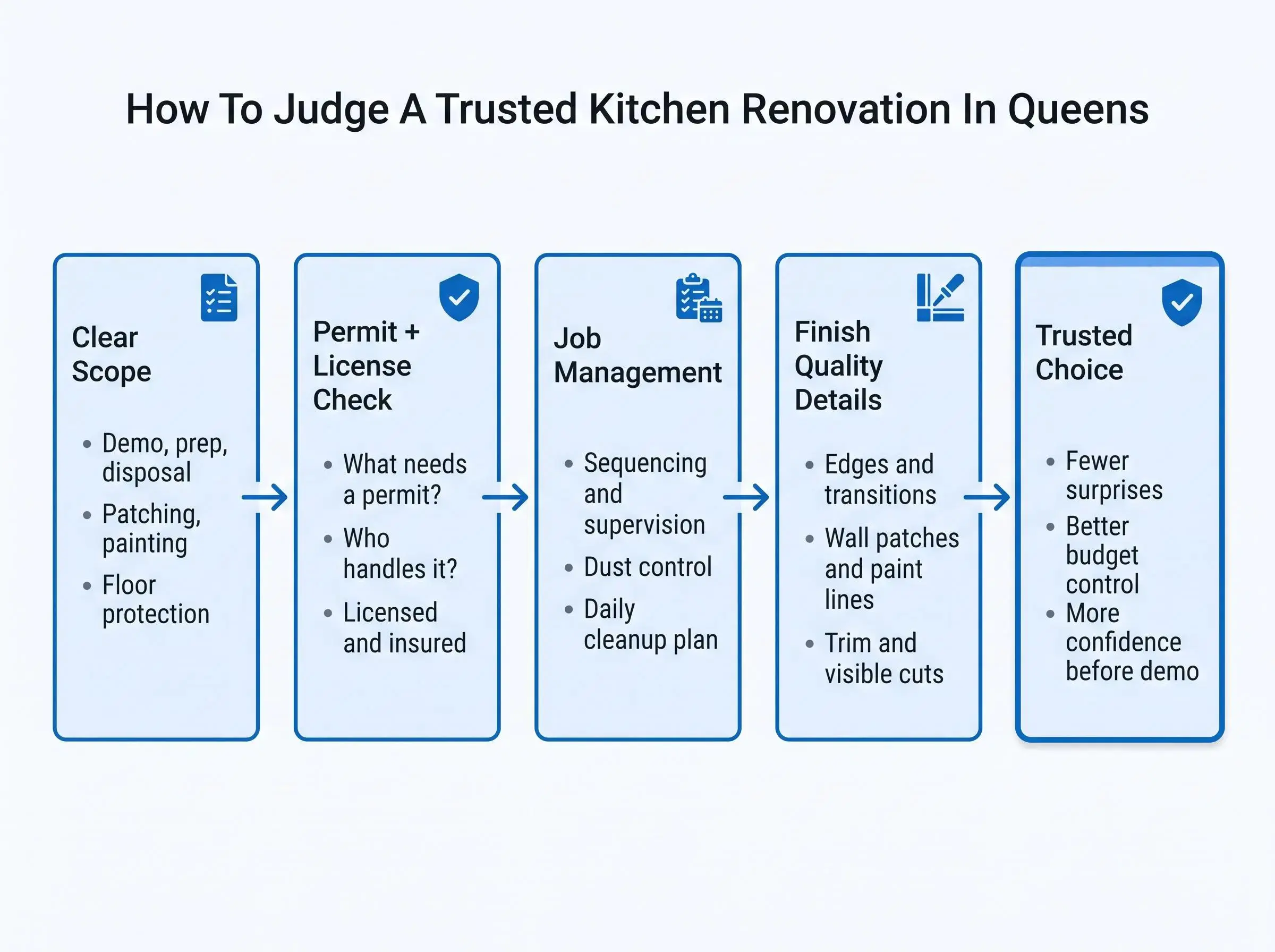
- Check if the estimate spells out demo, prep, disposal, patching, painting, and floor protection.
- Ask what needs a permit and who handles it before anything starts.
- Look closely at edges, transitions, and cleanup plans. That is where sloppy work shows first.
What Homeowners Really Mean by Trusted Kitchen Renovation Services in Queens
When people search for trusted kitchen renovation services in Queens, they usually aren’t asking for glossy photos or a polished pitch. They want to know who will actually show up, protect the home, price the work clearly, and finish without turning the job into a mess.
In practical terms, trust looks like a few non-negotiables:
- licensed and insured status
- clear communication before and during the job
- written, itemized pricing instead of vague allowances
- consistent workmanship on visible details
- accountability when something needs to be discussed or corrected
A kitchen is different from a simple paint job or a single-room flooring update. There are more moving parts, more decisions, more disruption, and more places where poor planning shows up fast. By the second afternoon, if the prep was sloppy or the sequence was weak, you feel it.
Most clients carry the same concerns into a project. Hidden costs. Dust drifting into the next room. A timeline that keeps sliding. A contractor who sounded confident at the estimate, then gets hard to reach once work starts. Fair concern. Kitchens expose weak operators quickly.
So the real goal isn’t finding the cheapest number. It’s finding a kitchen renovation Queens team that can manage details, explain scope in plain language, and stay responsible from demo to finish. That’s what this guide is for, whether you’re a homeowner, a property manager, or a small commercial client trying to make a smart call without getting buried in renovation talk.
Cheap pricing can hide expensive confusion.
What a Kitchen Renovation in Queens Usually Includes
Not every kitchen renovation is a gut job. Some projects are mostly surface and function upgrades. Others involve enough change that the schedule, budget, and coordination need a very different level of control.
A light refresh may include paint, flooring, backsplash, fixture swaps, and selected cabinet or countertop replacement. A fuller renovation can involve demolition, layout adjustments, new cabinetry, finish carpentry, flooring replacement, wall repair, and coordinated lighting or other trade work.
Here’s the basic split:
Light refresh
Best when the layout still works and you’re trying to improve appearance, storage, or wear.
Typical items:
- cabinet replacement without major layout change
- countertops and backsplash
- flooring updates
- wall prep and painting
- finish touch-ups and trim correction
Fuller renovation
This is where complexity rises. Not because the room is bigger, but because each step depends on the one before it.
Common elements:
- demolition of existing finishes or cabinets
- layout-related build prep
- cabinetry and surface installation
- flooring and transitions
- wall patching and painting
- detail work at edges, corners, and trim
For Queens clients, our Kitchen Renovation Services in Queens, NY fit naturally in that managed middle ground where practical coordination matters as much as design choices. If a project involves removing existing elements or preparing for layout changes, our demolition and installation framing support can be part of that prep. We keep it grounded. A kitchen with more trades and more handoffs needs tighter supervision, not just a longer estimate.
Why Queens Kitchens Need a Local, Permit-Aware Approach
Kitchen work in New York City isn’t just about what you want to change. It’s also about what the building, the city, and the job conditions allow. That’s where a lot of projects get into trouble.
Most construction in New York City requires Department of Buildings approval and permits, especially when the work changes structure or affects plumbing or mechanical systems. On the other hand, installing new kitchen cabinets by itself does not require a permit. That doesn’t mean anyone can do it. The contractor should still have the proper Home Improvement Contractor license through the Department of Consumer and Worker Protection.
If you’re comparing bids, especially from a licensed kitchen contractor Flushing option against a lower-priced operator with thin paperwork, verify the license status first. Don’t skip that step because the price looks attractive. A low number loses its appeal fast when permit issues or licensing problems start slowing the job down.
There are emergency situations too. If urgent repair work has to happen before a permit is issued, an Emergency Work Notification must be filed within two business days after the work is completed. That detail matters because emergencies don’t erase paperwork.
A trustworthy contractor won’t wave off permit questions or act annoyed that you asked. In Queens, paperwork is part of the job. Treating it like an afterthought usually means delays later, and delays in a kitchen hit daily life hard.
How to Evaluate a Kitchen Remodeling Contractor in Flushing or Anywhere in Queens
If you’re looking at a kitchen remodeling contractor Flushing homeowners can realistically vet, start with the basics and don’t let anyone rush you past them. The right contractor should be able to explain the work clearly without hiding behind jargon or broad promises.
Ask the obvious questions first:
- Are you licensed and insured?
- Do you have a local presence?
- Will the estimate be written and specific?
- Who supervises the work?
Then push a little deeper. This is where weak contractors start sounding slippery.
A serious contractor should be able to talk through:
- prep and protection of adjacent rooms
- daily cleanup expectations
- how changes are discussed and approved
- what assumptions are being made about existing conditions
- finish standards for paint lines, flooring edges, trim, and patching
That last part matters more than people think. A kitchen can have decent cabinets and still look rough if the cut lines are wavy, the floor transition is clumsy, or the wall patch flashes under light. Finish work tells on everyone.
Local accountability matters too. A kitchen remodeler Flushing NY clients can reach easily usually inspires more confidence than someone who seems to operate from a phone number only. And when you’re comparing contractors, pay attention to how they answer, not just what they charge. Evasive answers before the contract usually become frustrating answers during the job.
What a Strong Kitchen Remodeling Estimate in Queens Should Show
A useful kitchen remodeling estimate Queens homeowners can compare should reduce uncertainty, not create more of it. If the estimate leaves you guessing, you’re not holding a real price. You’re holding a starting point for later arguments.
Look for a written estimate that breaks out the major categories. Not every job will use the same line items, but the structure should be readable.
A strong estimate often separates:
- demolition
- site prep and protection
- installation labor
- finishes and touch-up work
- flooring
- painting
- framing or build-preparation work, if needed
- debris removal or cleanup
Be careful with broad lines like labor and materials. That’s where scope gaps hide. Maybe disposal isn’t included. Maybe surface repair is assumed to be minimal. Maybe touch-ups after installation aren’t covered at all. Those omissions become added costs later, and now you’re arguing over what was “understood.”
Read the exclusions as carefully as the inclusions. That’s operator advice, not legal advice. Exclusions tell you where the contractor expects friction.
Also ask one direct question: does this estimate reflect the actual site conditions you saw, or is it based on ideal assumptions? A price built on ideal conditions often stops being real after the first day of demolition.
Small Kitchen Renovation in Queens Requires Better Planning, Not Just Smaller Budgets
A small kitchen renovation Queens homeowners take on can be deceptively tricky. Less square footage doesn’t automatically mean less thought. Usually it’s the opposite. Every inch has a job.
In smaller kitchens, function comes from tight decisions:
- clear walking and opening space
- storage that uses depth and height well
- workable prep and cooking zones
- finishes that keep the room from feeling chopped up
- durable surfaces that can take daily use
The highest-impact upgrades aren’t always dramatic. Better floor continuity can make the space feel calmer. Cleaner wall finishes help more than people expect. Cabinet organization often beats adding more cabinet boxes. And in a small room, one awkward transition can pull your eye every time you walk in.
Poor sequencing hurts small kitchens more than larger ones. If deliveries land before the room is ready, the space clogs instantly. If demolition runs long, the room becomes harder to work in and harder to live around. There isn’t much margin.
We’ve found that compact kitchens reward restraint. Spend where function and finish quality show up every day. Simplify where complexity doesn’t buy you much. That’s where hands-on execution, careful painting, and flooring detail really matter.
The Renovation Process That Builds Confidence From Day One
A good process doesn’t make a renovation silent or effortless. It makes it understandable. That’s a big difference.
Here’s the sequence clients should expect from a trustworthy contractor.
How the project typically unfolds
- Consultation
Consultation and site review
We look at goals, pain points, visible wear, and what you're trying to preserve. Pricing before understanding the room is guesswork. - Scope and estimate
Scope definition and estimate
This is where the project gets real. What's being replaced, repaired, or left alone should be clear enough that the budget reflects reality. - Permit check
Permit and license check
If the work may need Department of Buildings approval, that should be confirmed early. Contractor licensing should be easy to verify, not awkward to discuss. - Pre-construction prep
Protection, demolition planning, delivery timing, and household logistics should be addressed before work starts. Not while dust is already in the hallway. - Construction
Construction and finish stages
Demo first. Then any needed framing prep. Then installation, flooring, painting, and detail work in a logical order that protects completed surfaces. - Final review
Walk the space. Check the agreed items. Handle punch-list details before calling it done.
Good process doesn’t remove all disruption. It removes avoidable confusion.
Surfaces, Flooring, and Finish Work Often Decide Whether the Kitchen Feels High Quality

Most people start with cabinets and countertops. Fair enough. But the finished impression of a kitchen often comes from the surfaces around them. Floors, walls, trim, patched areas, visible edges. That’s where quality either holds together or slips.
Kitchen light is unforgiving. It catches uneven paint, rough patching, bad caulk lines, chipped corners, and transitions that were rushed. A contractor who can’t speak confidently about prep probably won’t deliver a clean finish.
A few touch points tell you a lot:
- How are adjacent floors protected during the work?
- How are wall patches blended before painting?
- What happens at the edge where one flooring material meets another?
- Are visible cuts planned, or just hidden as best they can be?
If a kitchen project includes connected floor areas, our wood flooring installation and wood floor sanding and staining services can matter, especially when you’re trying to maintain continuity beyond the kitchen itself. The same goes for interior painting. In this context, it’s not about decorative hype. It’s about prep, clean lines, and surfaces that hold up under daily light and use.
The room doesn’t need to be flashy. It needs to look finished.
Material Selection Should Fit the Household, Not Just the Mood Board
Materials should match how the kitchen is actually used. Not how it photographs. That’s where a lot of expensive decisions go sideways.
Before choosing finishes, think through:
- how often you cook
- how hard you are on surfaces
- how much maintenance you’ll realistically keep up with
- what kind of storage frustration you’re trying to solve
- how the kitchen connects visually to the rest of the home
A material can look great on its own and still be wrong in the room. Flooring, walls, cabinets, counters, and backsplash need to work together under daily use, not just under showroom lighting.
Local sourcing can help. Queens clients may want to compare materials in person, and Long Island City has a supplier, Home Art Tile Kitchen & Bath, with tile, cabinets, countertops, and backsplash-related options. Sometimes seeing finishes side by side saves you from a rushed mismatch later.
Make selections early enough to protect the schedule. Late decisions create substitutions, and substitutions usually lower confidence fast.
Red Flags That Often Signal a Stressful Kitchen Remodel
Most stressful remodels announce themselves early. You just have to listen carefully.
Watch for these warning signs:
- unclear scope or vague promises
- pressure to commit quickly
- refusal to discuss licensing or insurance
- estimates with little detail
- unusually low pricing with no real breakdown
- weak answers about protection, cleanup, or debris removal
- no clear point of contact
- permit questions brushed aside
Very low bids deserve extra scrutiny. They may leave out prep, disposal, repair work, finish touch-ups, or realistic labor time. That’s not savings. That’s deferred conflict.
Finish-related vagueness is another big one. If a contractor can’t explain how they handle surfaces, edges, patching, and cleanup, quality usually suffers exactly where you’ll see it every day. Trust specifics over charm. Calm, detailed answers beat a polished pitch every time.
Questions to Ask Before You Hire a Kitchen Remodeler in Flushing, NY or Greater Queens
Bring a checklist into the conversation. You don’t need to sound like an expert. You need to hear whether the contractor does.
Ask these questions directly:
- Are you licensed and insured for this kind of home improvement work?
- Does this scope require a Department of Buildings permit, and if so, who handles that process?
- What exactly is included in the written estimate, and what is excluded?
- How do you handle demolition, protection, dust control, cleanup, and debris removal?
- If the layout changes, what build-preparation or framing work may be needed?
- How are added costs communicated if hidden conditions appear after demolition?
- Who is my main point of contact during the job, and how often will I receive updates?
- What finish standards do you follow for flooring, painting, patching, and visible detail work?
Use this with any kitchen remodeling contractor Flushing or Queens-based team you’re considering. The goal isn’t to trap anyone. It’s to find out who can answer clearly before your kitchen is half taken apart.
Why Hands-On Execution Matters More Than Big Promises
A lot of renovation problems come from the gap between what was sold, what was priced, and what actually happens on site. That’s the gap that creates stress, added cost, and bad blood.
Hands-on execution closes that gap. It means the work is managed by people who care about sequence, protection, details, and follow-through. Not just presentation. Not just speed.
At Ardson Construction, we focus on detail, clear pricing, and hands-on execution because that’s usually what cautious Queens clients need most. Kitchens don’t reward overpromising. They reward consistency. Prep done right. Questions answered early. Surfaces finished carefully. Cleanup handled like it matters, because it does.
Real trust is built in small moments. The estimate that makes sense. The protected floor path. The clean cut line. The call before a change becomes a surprise.
Conclusion
A successful kitchen renovation Queens project usually comes down to a few grounded things: proper licensing, permit awareness, transparent estimates, careful planning, and visible craftsmanship. Not flashy promises. Not the lowest number on the page.
If you’re feeling overloaded, that’s normal. The way through it is simple. Define the scope clearly, ask better questions, and get a written kitchen remodeling estimate Queens homeowners can truly compare. Then choose the contractor who communicates plainly, respects your home, and works with the kind of care you can actually see.