


Most Queens exteriors don’t fail all at once. If you’re asking how often to paint a house exterior, look past the faded color—peeling trim, split caulk, and bare spots are where water starts getting in.
A five-to-seven-year check is a sensible starting point, but your sunny wall and shaded porch may be on totally different clocks. Paint is protection, not just curb appeal.
Start your walkaround here:
- Check window trim and fascia for cracks after winter.
- Press suspect wood; soft spots need repair first.
- Watch south-facing walls for chalking and thinning paint.
Catch it early. Save the siding.
The Short Answer for Queens Homeowners
If you’re asking how often to paint a house exterior in Queens, start with this: take a serious look at the house around the 5 to 7 year mark. That’s a solid planning window for many homes when the last job was done well and the surface conditions were decent to begin with.
But that number is not law. It’s a checkpoint.
Some exteriors start failing earlier because the old prep was weak, the siding takes hard sun, or moisture keeps finding a way in around trim and joints. Others hold up longer because the surface was properly cleaned, repaired, primed, and painted with decent materials. That’s why the real question isn’t just how often to paint house exterior. It’s how your exterior is aging.
And paint is not only about looks. It is your first line of defense on wood trim, siding, and all those vulnerable details that get hit by sun, rain, humidity, and winter movement. Once the coating starts letting go, the clock speeds up.
Good timing saves money. Late timing usually creates repair work.
Why Queens Conditions Change the Repaint Timeline
Queens is rough on exterior paint in a very ordinary way. Nothing dramatic. Just constant wear from different directions.
You get humid summers, cold winters, rain, snow, and regular temperature swings. That back and forth matters more than people think. Exterior surfaces heat up, cool down, swell, dry out, and shift a little. Paint has to move with them. When it can’t, you start seeing hairline cracks, peeling edges, and spots where adhesion gives up.
Freeze-thaw cycles are especially tough. Water gets into tiny openings around caulk lines, nail holes, trim joints, or failing paint edges. Then winter does the rest. By spring, a small weak spot can turn into a visible problem.
Sun exposure creates a different kind of damage. The whole house may look fine from the curb, but south-facing walls and areas that get long direct sun often age faster. Colors fade. Surfaces chalk out. Some coatings get brittle before you notice obvious peeling.
Shade doesn’t mean safety either. Shaded sides tend to stay damp longer, especially near landscaping, fences, and lower wall sections. That’s where mildew, dark staining, and moisture-related paint failure like to start. We’ve seen plenty of houses where the sunny side looked tired, but the shady side was the one actually taking on water.
A few pressure points deserve extra attention:
- window trim and sills
- fascia and soffits
- lower siding near grade
- joints where two materials meet
- door frames and corner boards
National advice about how often should a house be painted tends to flatten all of this into one neat number. That number can be useful for budgeting. It is not enough to make the call.
Why There Is No One-Size-Fits-All Schedule
Houses do not wear evenly. Even the same wall doesn’t wear evenly.
This is where homeowners get tripped up. They want one clean answer for the whole property, but exterior paint doesn’t age like that. Trim often fails before siding. One elevation may be ready two years before the others. A protected rear wall can still look solid while front-facing wood details are already losing the fight.
You also have to separate cosmetic aging from protective failure. Fading alone might just mean the color is tired. That is not ideal, but it isn’t the same as a coating that has cracked open, thinned out, or pulled away from the surface. On the other hand, a house can still “look decent” from the street while caulk has failed around windows and water is already working into trim corners.
That tension matters. Delay isn’t always careless, but blind delay usually is.
Two neighboring homes can end up on totally different repaint schedules for reasons that aren’t obvious at first glance:
- one had better prep the last time
- one has tree cover and longer damp periods
- one gets harder sun on the front and side elevations
- one has gutters or drainage issues
- one owner catches small failures early and seals them up
A lot of people searching how often paint exterior of house are really asking a different question: “If I wait, am I saving money or creating a bigger problem?” The answer depends on whether the current paint is still protecting the surface. If it is, waiting may be fine. If it isn’t, waiting gets expensive fast.
How Exterior Material Affects How Often You Repaint
Material changes the whole conversation. The calendar alone won’t help much if you ignore what the house is actually made of.
Wood needs the closest watch
Wood siding and wood trim usually need more attention than anything else. Wood moves with moisture and temperature changes, and that movement puts stress on paint films. Once cracks open at joints, end grains, or trim edges, water gets a path inside. After that, you’re not talking about color anymore.
If your house has a lot of painted wood, don’t wait for dramatic peeling. Look for early signs.
Brick, aluminum, and engineered surfaces behave differently
Painted brick can often hold paint longer than wood when the system was right and the prep was done properly. Still, brick is not a free pass. Moisture trapped behind the coating can cause trouble, especially around mortar joints and openings.
Aluminum siding tends to resist moisture better, but sun exposure can show up as fading sooner than people expect. Sometimes the surface still has life left even when the color has flattened out.
Engineered wood and composite materials often go longer between repaints than traditional wood, but they still depend on the right prep and product choice. If the coating wasn’t suited to the surface, the age of the material won’t save it.
Mixed-material exteriors deserve a component-by-component review. Stucco, masonry, trim boards, porch details, and vinyl-adjacent elements don’t all age together. Treating the whole house as one uniform surface is one of the easiest ways to misjudge timing.
Signs It Is Time to Repaint Sooner Than Planned
Sometimes the house tells you pretty clearly that the schedule just moved up.
Peeling, blistering, flaking, and widespread cracking are strong signs the coating is no longer doing its job well. Bare wood or exposed primer is even more direct. At that point, the paint system has already broken down.
Here are the signs we take seriously:
- bare wood or primer showing through
- split or failing caulk around windows, doors, and trim
- paint lifting at edges, corners, or horizontal surfaces
- chalking that comes off on your hand
- rough, thin-looking coverage instead of a sealed finish
- dark mildew streaks that keep returning on shaded walls
- swelling, softness, or rot in wood details
Caulk failure deserves more respect than it gets. A lot of moisture problems start there before the field of paint looks bad. If joints around windows and trim have opened up, water can work in quietly for a while.
There is also a difference between touch-up territory and full repaint territory.
One or two isolated chips on a protected area may just need local prep and touch-up. A pattern of failures across multiple elevations, repeated peeling in moisture-prone areas, or general loss of adhesion usually points to a whole-house or at least multi-area repaint. Don’t let one bad board panic you, but don’t let ten bad details fool you either.
What Makes an Exterior Paint Job Last Longer
Longevity starts before the first finish coat goes on. That’s the part people want to skip because it isn’t visible once the job is done. It still decides most of the outcome.
A lasting exterior job usually includes the unglamorous work:
- power washing to remove dirt, chalk, and mildew
- scraping loose or failed paint
- sanding rough transitions and edges
- caulking gaps around trim, windows, and doors
- priming exposed wood and other bare areas
If wood is rotted, it should be replaced, not painted over. Paint is not a repair material. It can hide damage for a short time and make the next problem worse.
Different surfaces also need different handling. Wood, brick, stucco, and composite materials do not all want the same prep or coating approach. That’s where rushed jobs usually go sideways. A painter can move fast and still miss the whole point if the system doesn’t match the surface.
Application method matters too, just not in the simplistic way people think. Large siding areas may be sprayed or rolled for efficiency, while trim, windows, and door frames often need slower hand work to get clean coverage and proper detail. The finish you notice from the street often depends on the care taken in the narrow parts.
And yes, product quality matters. Better exterior paints are usually built for stronger adhesion, better flexibility, and better resistance to fade and weather wear than bargain-grade options. That doesn’t mean premium paint fixes bad prep. It doesn’t.
Our view is pretty simple. A detail-focused exterior painting job protects a property. A fast color-change job mostly photographs well for a week.
A Simple Queens Inspection Checklist You Can Use Each Year
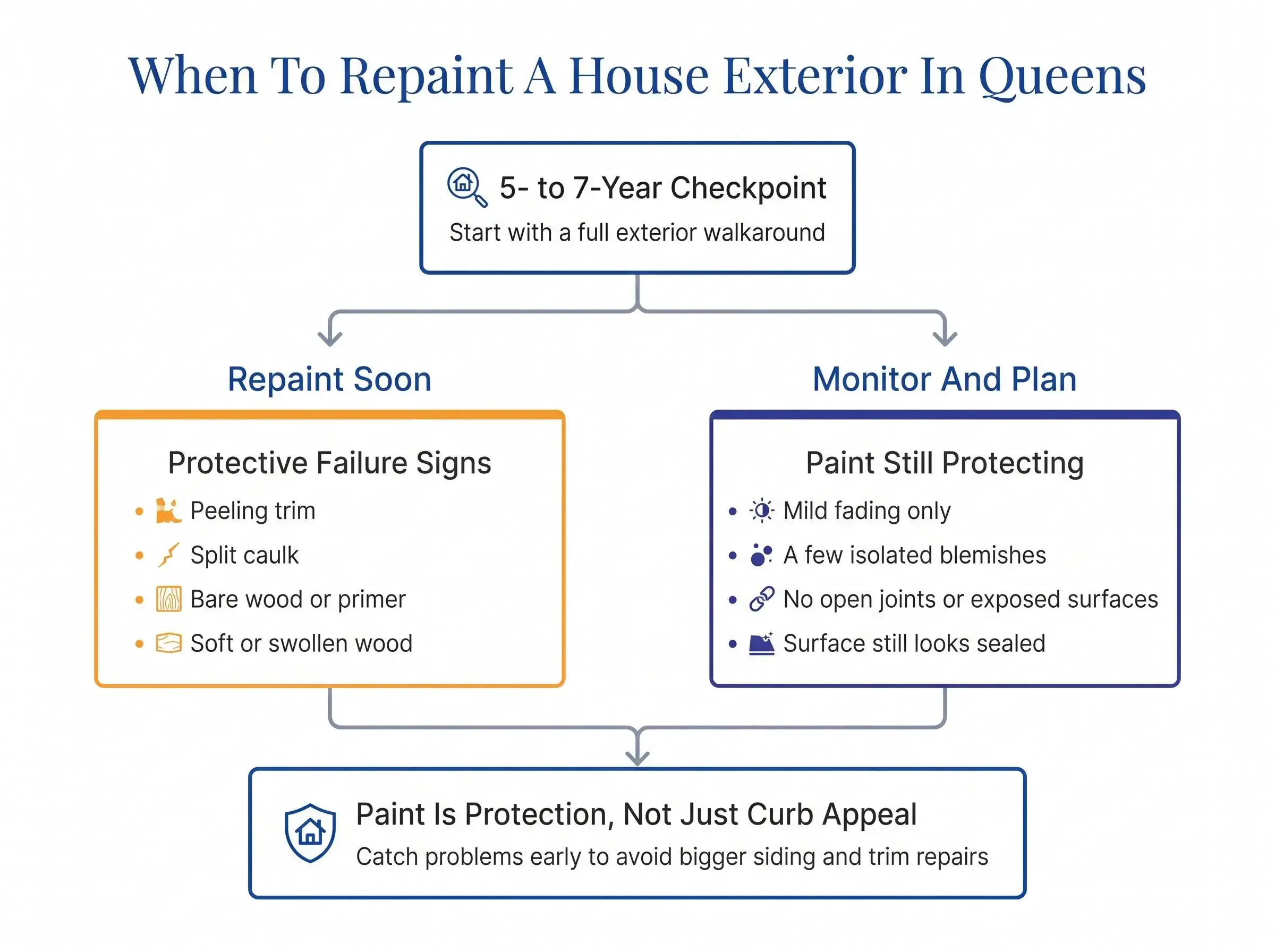
If you want a better answer to how often paint outside house, do one walkaround every year. Once is enough if you’re paying attention. Right after winter or just before the main painting season is a good time.
This doesn’t need to turn into a weekend project. Twenty minutes with your phone and a careful eye gets you most of the way there.
Walk the house in this order
Annual exterior check
- Sunny sides
Check the sunny sides first for fading, brittleness, and fine cracking.
- Shaded and lower areas
Move to shaded and lower sections. Look for mildew, damp-looking areas, and peeling near grade or dense landscaping.
- Trim first
Inspect trim before broad wall areas. Window trim, fascia, soffits, doors, and corners often fail first.
- Joints and seams
Look at joints and seams for split caulk, gaps, or staining.
- Test suspect wood
Press lightly on suspect wood. If it feels soft, swollen, or unstable, stop treating it like a paint issue.
Take photos of the same spots year to year. That part sounds small, but it’s one of the most useful habits a homeowner can build. It turns vague worry into comparison. You can see whether a crack stayed the same, whether a stain spread, or whether a trim corner is starting to move.
Maintenance gets easier when you stop relying on memory.
When It Makes Sense to Repaint and When It Makes Sense to Wait
Not every tired-looking exterior needs immediate repainting. Some do. The hard part is knowing which situation you’re in.
Repaint now if you have active failure: exposed substrate, widespread peeling, split caulk in vulnerable areas, repeated moisture staining, or wood elements that are starting to swell and break down. In that condition, waiting is rarely a smart savings move. You’re letting a coating problem drift into a repair problem.
Wait and monitor if the paint is still intact and the main issue is mild fading or a few isolated blemishes. In that case, repainting may be more about appearance than preservation, and that’s a budget decision, not an emergency.
Here’s the plain tradeoff:
- repaint too early and you may pay mostly for looks
- repaint too late and you start paying for carpentry and correction
We always tell people to think in terms of preservation. That’s the cleaner decision. If the visible color still looks acceptable but your trim corners, lower boards, or window surrounds are taking on moisture, the house may already be due for work in places most people don’t notice from the sidewalk.
Street appearance can be misleading. Water usually doesn’t care how the front elevation looks.
The Best Time of Year to Paint a House Exterior in Queens
Exterior painting needs a weather window, not a rushed opening on the calendar.
In practical terms, you generally want temperatures above 50 degrees and a dry stretch with no rain in the forecast. That gives the paint a fair chance to adhere, cure, and perform the way it’s supposed to.
Spring and fall are often easier than the extremes. Summer can work, but high heat and humidity can complicate dry times and application. Late fall and early winter can get risky fast, even when daytime temperatures look acceptable for a few hours.
Timing affects lifespan more than homeowners expect. Good paint put on in bad conditions can fail sooner than average paint applied at the right time on a properly prepared surface. That’s frustrating, but it’s true.
Try to plan before failure becomes urgent. Once you’re chasing a short weather window because trim is peeling hard or wood is exposed, corners tend to get cut. Prep gets compressed. Scheduling gets forced. Nobody does their best work under that kind of pressure.
Common Questions Behind How Often to Paint House Exterior
A few questions come up over and over, and they usually point to the same concern: whether you’re early, late, or somewhere in between.
Can touch-ups delay a full repaint?
Yes, sometimes. If wear is localized and the rest of the coating is still sound, touch-ups can buy time. They do not solve system-wide failure, and they won’t stop a broad adhesion problem from spreading.
Does one peeling area mean the whole house needs painting?
Not always. But it is a signal to inspect the rest of the exterior closely. Failure often starts in the most exposed or most vulnerable spots first, then shows up elsewhere later.
Does newer paint always last longer?
No. A recent job can still fail early if prep was weak, deteriorated material was painted over, or the wrong coating was used for the surface. Newer doesn’t automatically mean better.
Will repainting fix moisture problems?
No. Paint helps protect surfaces, but it can’t fix failed caulk, rot, drainage issues, or ongoing water intrusion by itself. If moisture is the cause, that has to be addressed first.
Should commercial and multi-unit properties think about timing differently?
Yes, but only partly. Appearance, tenant perception, and maintenance planning matter more on those properties. The decision still comes down to the same basics: condition, exposure, material, and prep quality.
If you’re asking how often should a house be painted, don’t force the answer into one number. Ask whether the current paint is still protecting the building envelope. That’s the real job.
What to Ask Before Hiring an Exterior Painter
The questions matter as much as the price. Sometimes more.
A decent proposal should tell you whether the contractor sees a full repaint, targeted repairs, or a wait-and-monitor situation. If every house gets the same answer, that is a bad sign.
Ask these directly:
- How do you decide if this house needs repainting now or later?
- What prep is included: cleaning, scraping, sanding, caulking, priming?
- How do you handle deteriorated or rotted wood?
- Does the process change based on the siding and trim materials on this house?
- Are trim, window surrounds, and other vulnerable details treated separately?
- How do you schedule around weather instead of forcing the job through?
- Can you break out pricing by scope and condition issues?
We think clear pricing and hands-on execution matter because repainting too soon wastes money, and repainting too late usually hides a condition problem inside a paint estimate. Ardson Construction is licensed and insured, and our interior and exterior painting approach stays rooted in the details that actually affect lifespan, not just color selection and start dates.
Conclusion
For Queens homes, a close exterior review around 5 to 7 years is a smart place to start. But the real answer to how often to paint a house exterior depends on material, sun exposure, moisture, prep quality, and how the current coating is actually performing.
You don’t need to guess, panic, or wait until the house looks rough from the street. A careful inspection will usually tell you whether it’s time to repaint, repair first, or keep monitoring for another season.
If you want a clearer read before small issues turn into bigger ones, Ardson Construction can help evaluate your exterior and give you a realistic sense of what needs attention now and what can reasonably wait.